
Tulip Mania!
The First (of many) Economic Bubbles was Built on Flowers.

Happy first day of spring!
It’s a fitting moment to revisit one of history’s strangest seasons, when flowers became fortunes, and a single tulip bulb could command the price of a house. In 1630s Holland, as the ground thawed and tulips pushed up toward the light, this natural cycle collided with something far less predictable: human speculation. Tulip Mania, as the event came to be known, pushed financial systems to their limits and became one of the earliest examples of the now all-too-familiar economic bubble.
The Dutch Tulip Business
It’s somewhat surprising how many plants, fruits, and vegetables we associate with Europe were actually introduced relatively recently. Tomatoes and potatoes, now central to countless iconic European dishes, arrived from South America in the 1500s. Pepper and nutmeg, staples in Spanish and French cooking, were brought from South and Southeast Asia as late as the 1600s. But don’t worry, before then, Europeans had their own native fare: turnips, parsnips, cabbage, and leeks. Yum.
Tulips arrived in Europe in 1554 from the Ottoman Empire, where they grew on the mountain slopes of Central Asia. At first, Vienna and Amsterdam competed to dominate the emerging tulip market. But the alliterative Dutch botanist Carolus Clusius tipped the balance when he cultivated larger, more vividly colored blooms and cemented the flower’s fate as a Dutch staple.

The rise of the tulip coincided with the rise of Holland. After declaring independence from Spain in the late 16th century, the new republic attracted scientific and artistic talent from across the continent. For a roughly one-hundred-year period known as the Dutch Golden Age, this influx of trade, art, culture, and relative religious tolerance helped make the Dutch Republic the most powerful society in the world.
As their country grew more powerful, some in Holland saw their wealth increase immensely, and with it came a desire for status symbols. The new and beautiful tulip filled this role perfectly. The trend began when some of the wealthiest Amsterdammers lined their canal-side homes with tulips each spring. Local shops and eventually national growers capitalized on this demand by marketing new varieties produced through variations in growing techniques. The most valuable were “broken tulips,” prized for their striking, flame-like patterns when fully in bloom. Competition to sell them was fierce: one grower introduced a flower dubbed “the Admiral,” another responded with “the General,” followed by ever more extravagant names like “the Admiral of Admirals” and “the General of Generals.”
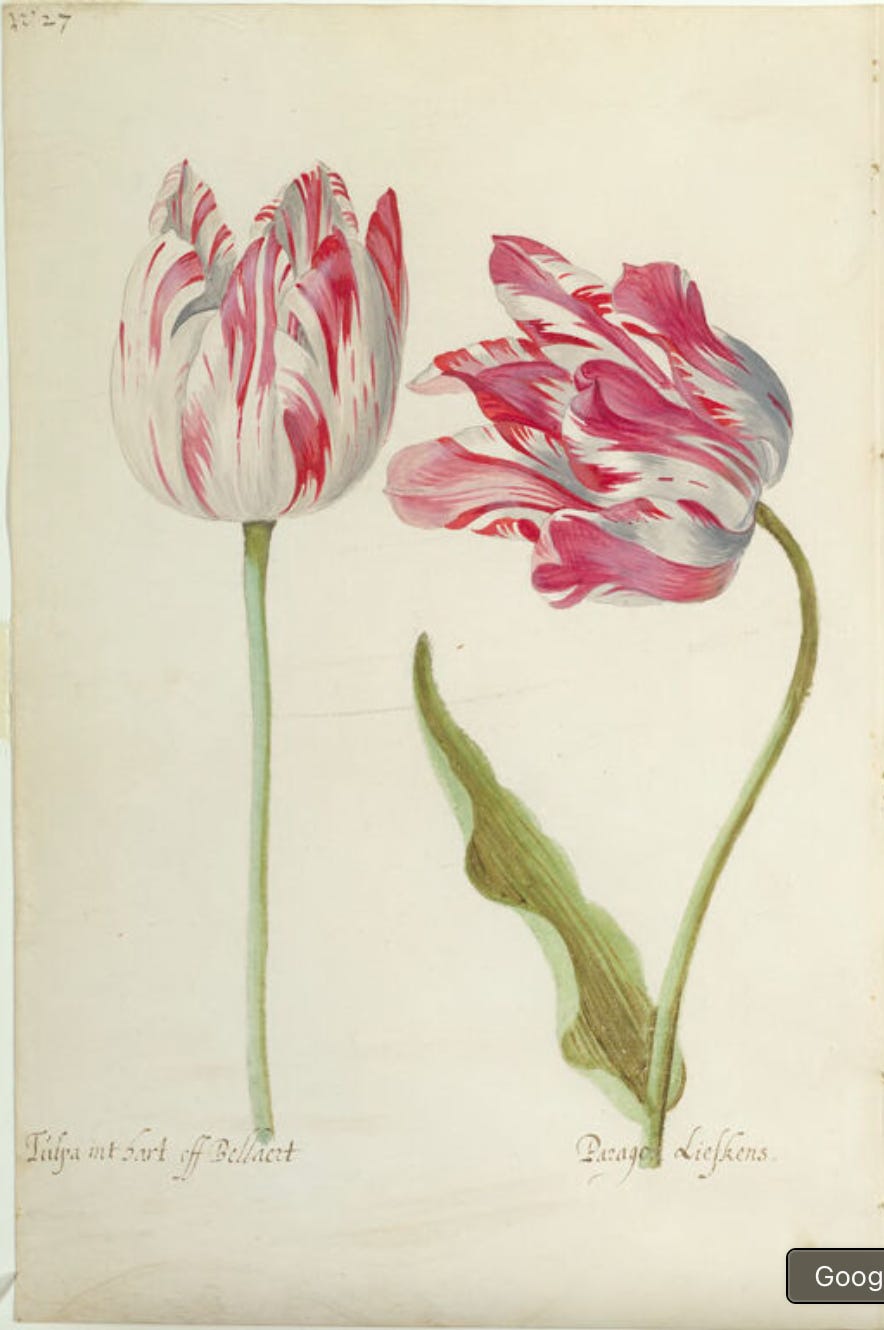
The Rise
As the tulips became ingrained in Dutch culture, they also became ingrained in the Dutch economy. Tulips bloomed for only a week or two each spring, and their bulbs could be dug up and moved only between June and September. So, the actual, physical trade in tulips was confined to a narrow window. But as the tulip market grew more profitable, and more speculative, traders wanted a way to keep buying and selling year-round.
Their solution was the futures contract. A grower would agree to deliver a specific tulip bulb at a set price once the next season arrived, and a buyer would sign on to purchase it in advance. Crucially, these contracts didn’t just sit still; they were resold again and again during the off-season, often at higher prices each time, as new buyers bet on further increases. When spring came, the final holder would complete the purchase. The catch was that for most of this process, the tulip didn’t even exist yet: people were trading the idea of a flower.
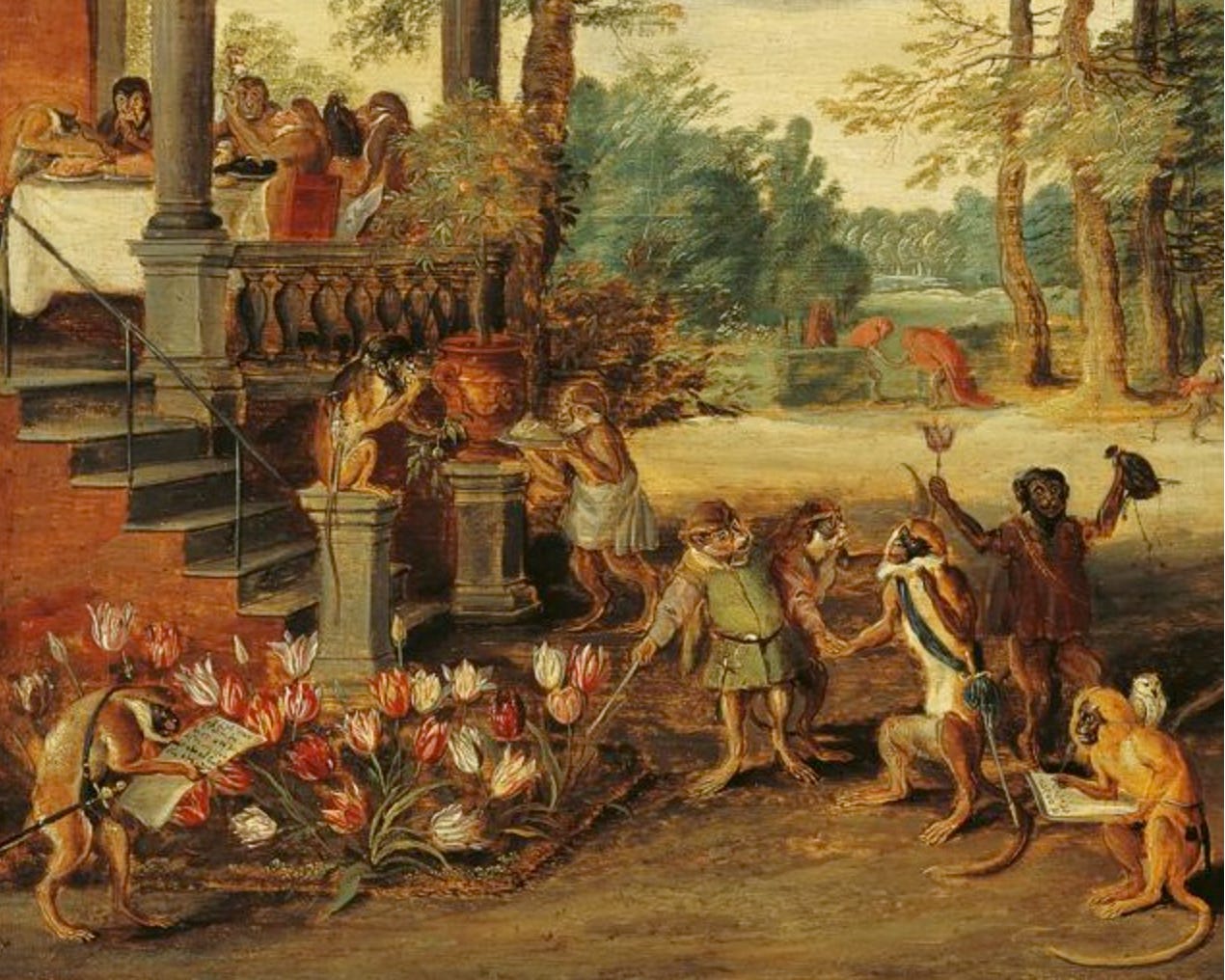
The vast majority of contract buyers and sellers were not gardeners or wealthy collectors hoping to display tulips on their estates. Instead, they were middlemen, speculators who often never saw a real tulip bloom. By the 1630s, the country was awash with these traders, known as “florists.” Foreign buyers, including the French and Spanish, joined the futures market, eager to share in what seemed like endless gains. Even the cheaper “unbroken” tulips saw their prices skyrocket. A single bulb could double in value from one contract holder to the next. At the peak of Tulip Mania in February 1637, a single “Admiral” bulb contract sold for more than 2,500 guilders, enough to purchase 20,000 pounds of cheese or 250 sheep.
A Scottish historian, Charles Mackay, wrote about the prevailing sentiment of the time:
“Everyone imagined that the passion for tulips would last forever, and that the wealthy from every part of the world would send to Holland, and pay whatever prices were asked for them. They were wrong.”
The Fall
No one knows exactly when the bubble burst. The most common story places it at a charity auction, where the “Semper Augustus,” which could usually command the same price as a canal-side home, was offered initially at a cheap opening bid. No one took it.
Perhaps buyers had begun to realize that sellers now outnumbered them, or that international demand was weaker than expected. Or maybe, at last, they confronted the simple reality that they were spending generational wealth on a single flower. Whatever the reason, no one bid on the bulb. The price was lowered again and again, and still, no one stepped forward.
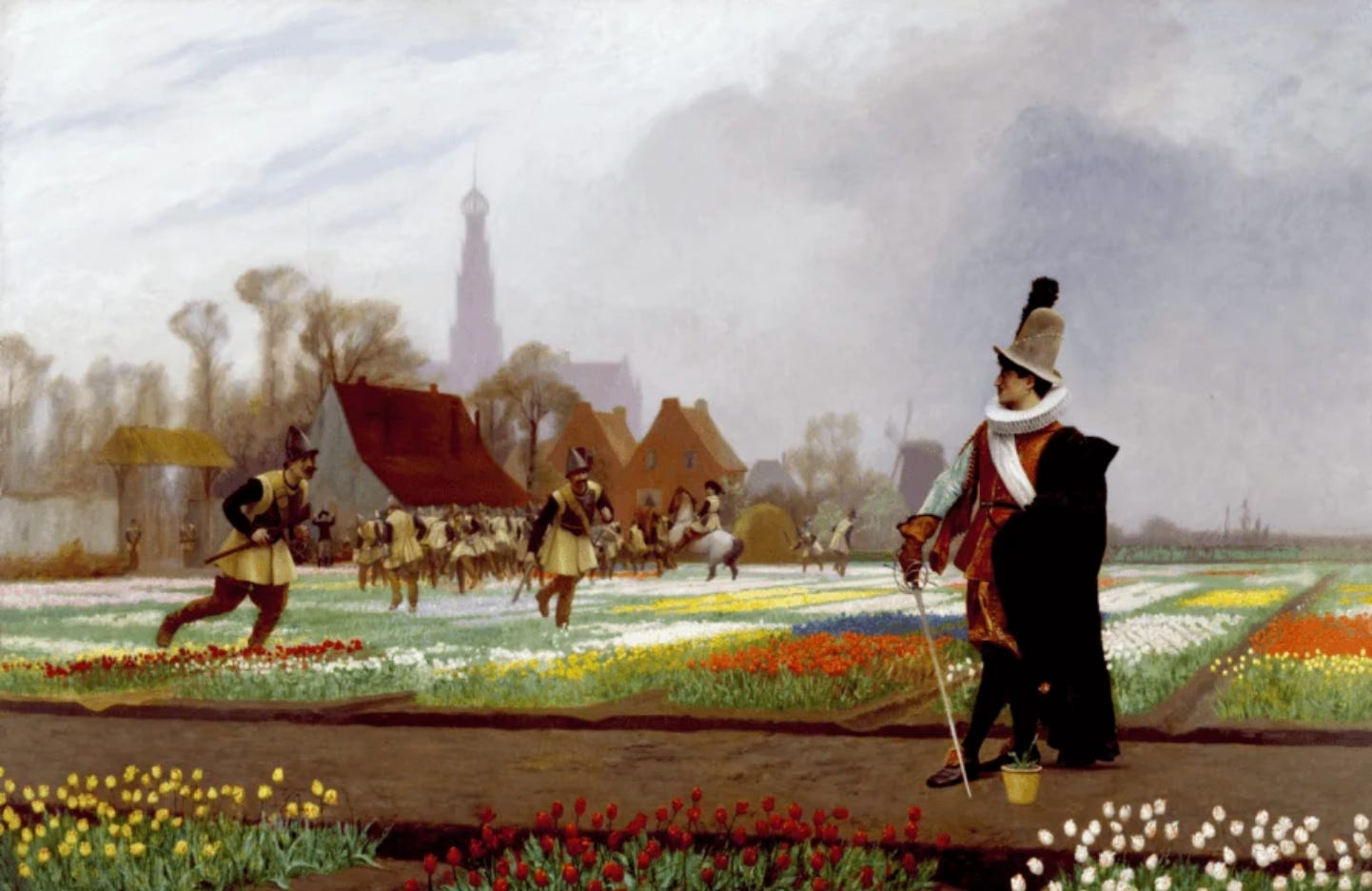
News spread quickly, and in less than a week, tulip prices collapsed. Contract holders who had paid enormous sums suddenly found themselves with no buyers. They turned to the government for relief, but because many of these contracts were not legally binding, officials were initially reluctant to intervene.
As the crash began to spill into the broader economy, however, the government stepped in. The tulip trade was suspended, and contract holders were offered the option to cancel their agreements by paying a 10% fee to the growers. By spring, when the tulips finally bloomed, almost none of the outstanding contracts were honored.
Alternative Explanations
Some historians have offered evidence that complicates the traditional story of Tulip Mania. In Nature’s Mutiny, Philipp Blom suggests the mania may have been shaped in part by the instability of the Little Ice Age, which disrupted agriculture and heightened uncertainty across Europe. Others point to a relative lull in the Thirty Years’ War during the 1630s, which may have freed up capital and attention for speculative ventures like tulips. Still others argue that Tulip Mania has been overstated altogether, that it was a relatively contained phenomenon, limited to a small circle of wealthy men whose massive losses were real, but whose importance was exaggerated in historical accounts.
Further Thoughts
The Dutch Golden Age produced many of the financial institutions we still recognize today: stock exchanges, credit markets, and, as Tulip Mania makes clear, economic bubbles. The most obvious modern comparisons are cryptocurrencies and NFTs: assets built on the promise of future value, detached from anything tangible.
Additionally, it’s hard not to see echoes of Tulip Mania in today’s surge of AI investment. Money poured in from across the world on the promise of more beautiful tulips next spring, year after year, until it all fell apart. Today, trillions of dollars flow into half-formed AI products with no guaranteed outcomes. A single tulip bulb may seem like the sillier investment, but at least, if worse came to worst, it would still look good outside your house.
There’s also something to be said about the fact that the mania was largely confined to a small group of wealthy traders whose reckless speculation led to their own financial ruin. But because their fortunes were significant enough to ripple through the broader economy, the government stepped in to soften the blow. Their status also amplified their story to dominate how the event was remembered.
This pattern has repeated itself in modern history, from the role of major banks in the 2008 financial crisis to massive economic interventions during COVID, and it will likely happen again when the current AI bubble finally pops. Tulip Mania hints at one of capitalism’s original flaws: the system allows the wealthy and powerful to take outsized risks, often with the implicit backing of entire economies, while those with the least remain afterthoughts.
The “greater fool” theory states that an overvalued asset can keep rising in price as long as there’s someone dumber willing to pay more. But the theory implies an ending: a greatest fool left holding a million-dollar tulip.
Works Cited
Boissoneault, Lorraine. 2018. “There Never Was a Real Tulip Fever.” Smithsonian Magazine. https://www.smithsonianmag.com/history/there-never-was-real-tulip-fever-180964915/.
Dash, Mike (2011). “Tulipomania: The Story of the World’s Most Coveted Flower and the Extraordinary Passions It Aroused.” New York: Three Rivers Press. ISBN 978-0-307-56082-7.
Fogarty, Erin. 2024. “A Brief History of Tulips.” Massachusetts Horticultural Society. https://www.masshort.org/blog/tulips.
“Holland and Tulipmania.” n.d. Amsterdam Tulip Museum. Accessed March 20, 2026. https://amsterdamtulipmuseum.com/pages/tulip-history-tulipmania-netherlands.
Mackay, Charles (1841), “Memoirs of Extraordinary Popular Delusions and the Madness of Crowds,’ London: Richard Bentley.
Mark, Joshua. 2022. “Eighty Years' War.” World History Encyclopedia. https://www.worldhistory.org/Eighty_Years'_War/.
Philipp Blom, “Nature’s Mutiny: How the Little Ice Age of the Long Seventeenth Century Transformed the West and Shaped the Present,” New York: Liveright, 2019.
The human instinct to just pick something and assign it astronomical value is fascinating. Sooner or later someone is going to realize the 16.5 million dollar pokemon card they have in their vault is just a little piece of cardboard and it’s probably going to happen right after it gets 0 bids at auction.
I will re-read this one when the AI bubble bursts